
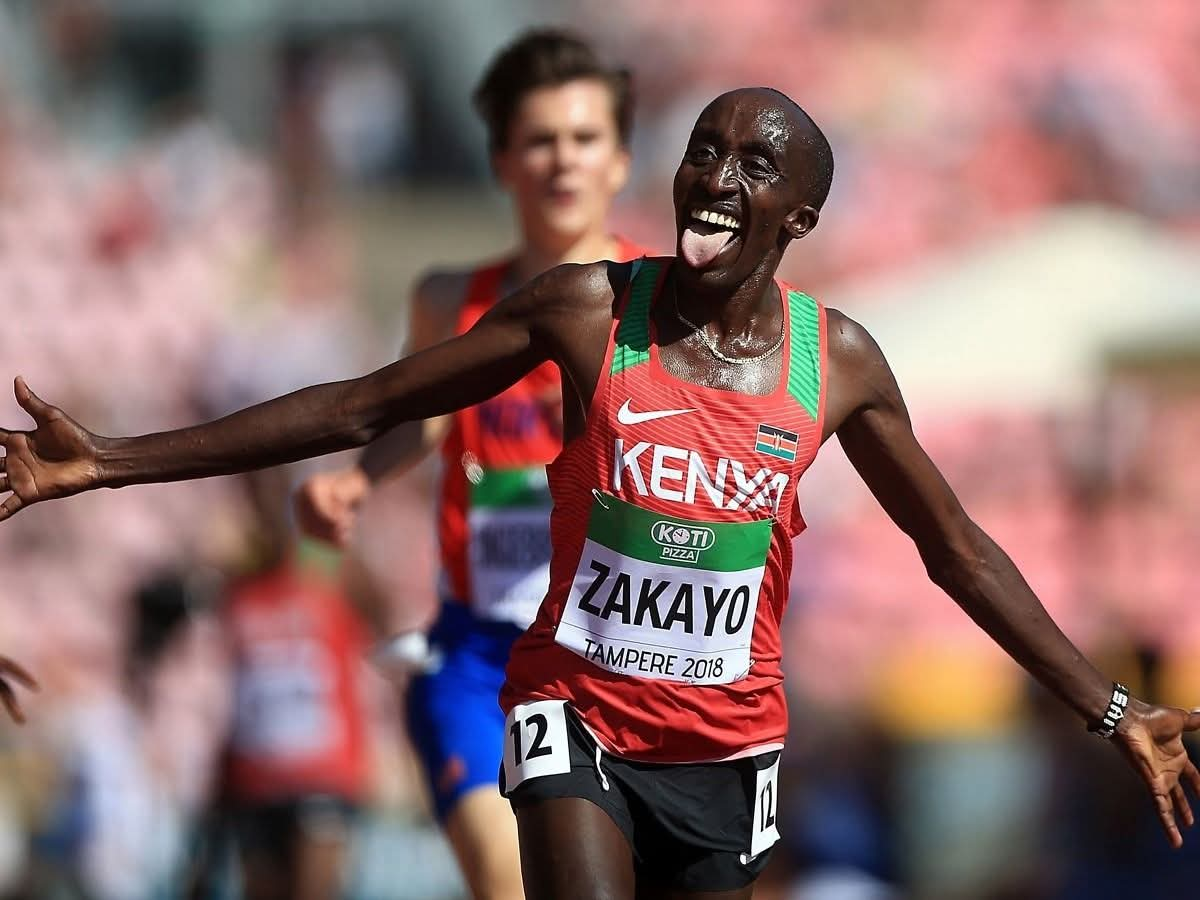
For most young athletes, the dream is simple: run fast, win races, and change lives. For Edward Zakayo, that dream was no different.
Since bursting onto the athletics scene in 2015, the 23-year-old long-distance runner from West Pokot carried only one goal — to lift his family out of poverty and build a life through his God-given talent.
“I was born to run,” Zakayo said softly. “And since 2015, I have carried only one dream — to change my life and my family’s life through athletics. I trained with pain, discipline, and hope.”
But today, Zakayo sits not as a champion, but as a suspended athlete. His story is not about doping, not about cheating, but about something so ordinary it almost sounds unbelievable — a lost phone.
The nightmare began on November 29th, 2023, after a race in Spain. Zakayo was exhausted. He had finished the competition and boarded a connection flight through Dubai on his way back to Nairobi.
“My body was so tired I could barely think,” he recalled. “During my connection flight in Dubai, I realized too late that I had forgotten my small hand luggage bag inside the plane. Inside that bag was everything — my phone, a power bank, and the only access I had to my ADAMS account to update my whereabouts.”
Zakayo begged the airline staff to let him back in. “Please, I left my bag on the plane. My phone is inside. Can I go back?” he pleaded. But the response was firm: “No, you cannot. For security reasons, once you exit you cannot re-enter.”
The lost-and-found desk told him his bag would be brought after four hours. But he only had 30 minutes before his connection to Nairobi. Missing that flight, he feared, would anger his manager. So, with a heavy heart, he boarded without the bag.
Back in Kenya, he tried everything to recover his line. “I explained my situation to ADAK officers. One of them told me: ‘Just replace your Safaricom line.’ But when I went to Safaricom, they told me, ‘We cannot. That line is still active in Dubai. Come back when the phone switches off.’”
Weeks turned into months. His ADAMS account, which athletes use to update their daily whereabouts for drug testing, remained unreachable. Finally, in April 2024, he managed to replace his line.
With new hope, Zakayo met ADAK officers at Lornah Club. “They looked into my account. One officer said: ‘You don’t have any missed tests.’ I smiled and told them, ‘Yes, I know. I have been careful.’” But that joy was short-lived. Soon after, ADAK refused to correct his whereabouts.
“Then suddenly, they turned around and gave me a missed test,” Zakayo said. When he asked whether they had checked before issuing the missed test, he was told, “That’s not your business,” before the officer hung up on him. For Zakayo, it was no longer about rules. “That was the moment I realized this was about something else,” he sighed.
In May 2024, during the National Trials at Kasarani Stadium, Zakayo faced fresh humiliation. He went to collect his race number but was tossed around between ADAK and Athletics Kenya officials.
“From morning until night, I was moving between those tables,” he said. “Seven times they sent me back and forth. I was tired, hungry, but determined.”
At last, a foreign ADAK official with long hair told him: “You don’t have any problem. Pick your number and go.” But by then, the damage was done. His chance to represent Kenya was gone.
Instead, Zakayo turned to international road races. He competed in Nigeria, Gabon, and Istanbul. He won races, but his heart was heavy. “Every race I ran with tears inside me,” he said. “But I told myself: at least I can still provide for my family.”
Zakayo trained with determination for the Copenhagen Half Marathon on August 9th, 2024. That race was going to be his breakthrough. “That race was my hope,” he said. “It was going to feed my siblings, keep my sister in school, and prepare me to welcome my unborn child.”
But on August 6th, just three days before the race, a call shattered everything. His agent called him. “My brother… do you know you are suspended?” Zakayo was shocked. “What? How? Who told you?” The agent sent him screenshots of his conversation with Athletics Kenya officials.
“Your athlete is suspended,” they had told him. “I felt my knees go weak,” Zakayo recalled. “I asked him, ‘Why now? Why after all this time? Why let me train, run, suffer, and then destroy me?’”
Zakayo now finds himself in limbo — not because of drugs, not because of dishonesty, but because of bureaucracy, miscommunication, and perhaps, as he says, “powerful people who never wanted to listen.”
“I trained with pain, with hope, with everything I had. And now, I sit here broken, not because I cheated, but because I lost a phone,” he said quietly.
For him, the suspension feels like the end of a journey he worked for almost a decade. But even in his pain, he holds on to a flicker of hope.
“I still believe God gave me this talent for a reason. Maybe one day, people will understand my story. Maybe one day, I will run again — not just for medals, but for my family, for the little boy who started running in West Pokot, and for the dream I still carry inside me.”
The story of Edward Zakayo is one that highlights the fragile line between success and despair in athletics. A forgotten bag, a lost phone, and a series of misunderstandings have left one of Kenya’s brightest talents on the sidelines.
For Zakayo, the fight now is not just about races. It is about truth, dignity, and the dream of a young man who believes he was born to run.
You may also like
FOOTBALL
FOOTBALL
FOOTBALL
VOLLEYBALL

ATHLETICS
World Athletics has unveiled demanding qualification standards for the 2028 Los Angeles Olympic Games, giving...
OLYMPICS
Kenyan fencing youngster Aliyah Makena is determined to build on her experience at the Dakar...